The power of helping: Donations that transform education in Santa Ana
Updated: May 19
Education in rural areas like Santa Ana, Magdalena (Colombia), faces persistent challenges: a shortage of basic materials and insufficient technological infrastructure. A group of university graduates, with the support of W Radio and other organizations, drove a donation initiative that benefited two educational institutions in the municipality: the Rafael Jiménez Altahona Educational Institution and the Antonio Brugés Carmona School.
The Power of Helping
Origin of the initiative
The initiative originated from the circulation of a journalistic article in which students from Santa Ana expressed their concern about educational abandonment in their region. Some time later, one of the readers of that article was contacted by a teacher with family ties in Santa Ana, which prompted an initial exploration of local needs. The teacher reached out to several local educational institutions, obtaining clear responses from the Rafael Jiménez Altahona Educational Institution and the Antonio Bruges Carmona School.
With this information, the situation was shared in a WhatsApp group of graduates of Mechanical and Industrial Engineering from the Universidad del Atlántico, based in different countries. From that point, a donation process was organized based on the specific needs the principals had communicated.
Notebook donation to Rafael Jiménez Altahona Educational Institution
The graduates coordinated the delivery of 1,380 notebooks to the Rafael Jiménez Altahona Educational Institution. Principal Cesar Larios highlighted that the lack of basic materials, such as notebooks, discourages many parents from sending their children to school, evidencing the economic difficulties of the community. In rural areas, where numerous families cannot afford school supplies, this situation becomes an obstacle to access and permanence in education.

The power of helping: students from Rafael Jiménez Altahona Educational Institution receiving the donation
Thanks to the generosity of Ivan Altamar, Dante Barraza, Julissa Barraza, Pedro Barrios, Milton Coba, Henry de la Peña, Jaime Garcia, Alejandro Hernandez, Ana Lopes, Edgar Mauricio Mejia, Hainer Mejia, Alfonso Navarro, Pedro Pablo Peñaranda, Edwin Polo, Alfredo Polo, Javier Rodriguez, Adolfo Silva, Javier Trespalacios, Carlos Velilla and Omar Vasquez, it was possible to gather the necessary resources for this donation.
Principal Larios delivering the donation
The availability of basic materials can help improve learning conditions and reduce one of the barriers that lead families to withdraw their children from the school system.
School kits for Antonio Brugés Carmona School
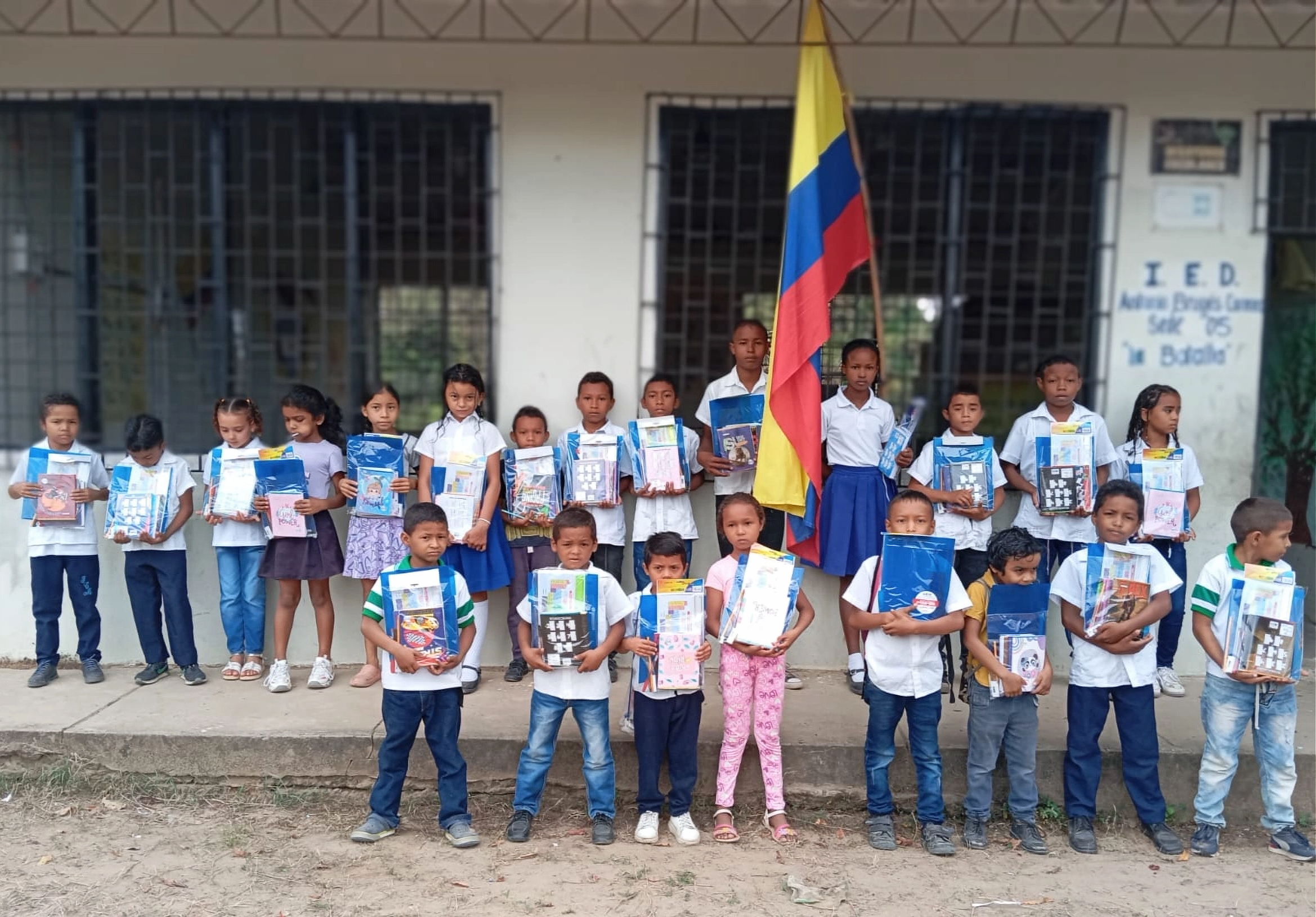
The delivery of 550 school kits to Antonio Brugés Carmona School was managed by the graduates in alliance with W Radio, led by Julio Sanchez Cristo and the Diana Group. The kits include notebooks, colors, pencils, erasers, and other essential materials for students' academic development.

Educational kits received by students from Antonio Brugés Carmona School
Principal Alex Jiménez highlighted that this contribution alleviates the economic burden of many families and strengthens parents' commitment to their children's education, encouraging attendance and interest in learning.

Educational kits for Antonio Brugés Carmona School
Having adequate school materials is a basic condition for learning, especially in contexts where families cannot afford them. The coordination between graduates, media outlets, and private enterprise illustrates a model of collaboration that can prove effective in rural communities with limited resources.
Computer and robotics room: Technology for the Future
The Ministry of Information and Communications Technologies (MinTIC), in alliance with W Radio and with the management of the group of Mechanical and Industrial Engineering graduates from the Universidad del Atlántico, delivered more than 400 computers and enabled a computer and robotics room at Antonio Brugés Carmona School. Access to this technological infrastructure gives students the opportunity to develop digital skills that broaden their educational and professional prospects.

New computer room at Antonio Brugés Carmona School
The principal highlighted that the equipment will also be available for other educational institutions in the region, expanding the project's reach. Additionally, he noted that this initiative will allow students to access specialized degrees in robotics and computer basics, strengthening their technical and professional training. The school is exploring international collaboration agreements, including with the International Labour Organization (ILO), with the aim of facilitating student participation in training programs and technology and robotics competitions, the principal indicated.

New robotics room, Antonio Brugés Carmona School
Recognition of principals: Leaders committed to educational transformation
In Colombia, there are true heroes without capes who, with deep vocation, lead significant changes in education that impact the lives of thousands of students. Principals Alex Jiménez and Cesar Larios illustrate this kind of engaged management: their work helped connect the concrete needs of their institutions with resources contributed by external actors.
Their commitment demonstrates that institutional engagement can be a determining factor in improving local educational conditions.
Contribution to Sustainable Development Goals (SDGs)
These actions are aligned with several Sustainable Development Goals:
SDG 1: No Poverty: By providing school materials and technology, concrete barriers to educational access are reduced — barriers that, in contexts of poverty, are often determining factors for school retention.
SDG 4: Quality Education: The delivery of school kits and the setup of computer facilities expand the material conditions for more complete learning, though the quality of education also depends on pedagogical factors and continuity that go beyond the provision of materials.
SDG 8: Decent work and economic growth: Training in digital and technical skills expands students' educational options. Its effect on regional employment and local economic growth will depend on additional factors — such as educational continuity and local labor market demand — that require medium-term monitoring.
SDG 9: Industry, innovation and infrastructure: Setting up this room represents a concrete improvement in available educational infrastructure and gives students a first exposure to technological tools. Its long-term effect will depend on pedagogical support and sustained maintenance of the equipment.
SDG 10: Reduced Inequalities: Decreasing educational gaps in rural areas. By focusing efforts on communities with fewer resources, equity is promoted, and more young people are ensured access to the same training opportunities, regardless of their place of origin or social condition.
SDG 17: Partnerships for the Goals: Promoting collaboration between the university, business, and state. The coordination between graduates, educational institutions, the private sector, and media like W Radio demonstrates how strategic alliances enhance the impact and sustainability of initiatives, allowing the achievement of goals that would be impossible to reach in isolation.


SDG 1: No Poverty, SDG 4: Quality Education, SDG 8: Decent Work and Economic Growth, SDG 9: Industry, Innovation and Infrastructure, SDG 10: Reduced Inequalities, and SDG 17: Partnerships for the Goals
The actions described address immediate needs — school materials and technological infrastructure — and fit within broader development frameworks, such as those proposed by the 2030 Agenda, though their contribution to these goals should be understood as partial and long-term.
Conclusion
The power of helping is a transformative force that, although it may seem small at the beginning, can generate great changes when the will and commitment of many people unite. As principals Alex Jiménez and Cesar Larios affirm, "1 is more than 0," a phrase that reflects the importance of each contribution, however small, to improve education in Santa Ana.
This experience illustrates how the coordination of different actors — graduates, media, private enterprise, and public bodies — can translate into concrete improvements for rural educational institutions. The provision of materials and technological infrastructure addresses immediate needs that ordinary institutional budgets do not always cover. Initiatives of this kind can serve as a reference for other communities in similar conditions, though their sustainability depends on institutional commitments that go beyond one-time donations.
The initiative's outreach benefited from the support of Julio Sánchez Cristo and W Radio, whose coverage helped expand the project's reach.
1 is more than 0...
Bonus Track


Notebook donation to Rafael Jiménez Altahona Educational Institution


Comments