The Fogg Model Applied to the Design of Sustainability Apps

Updated: Jul 12
Various opinion surveys conducted over the last decade indicate that a significant share of the population considers climate change an important problem and expresses concern about its potential environmental, social, and economic consequences (European Commission, 2017; Pew Research Center, 2015). However, turning that concern into concrete actions — sorting waste, reducing energy consumption, choosing sustainable transport — proves difficult. In most cases, this is not a matter of indifference or lack of will. Real barriers exist: psychological, social, and structural [1], which prevent knowledge from translating into practice (Gifford, 2011; Lorenzoni, Nicholson-Cole, and Whitmarsh, 2007).

Suforall's Instagram
Faced with this problem, BJ Fogg's Behavior Model (FBM) [2] offers a useful conceptual framework for understanding why people act or fail to act, and for designing digital environments that reduce behavioral friction [3] that blocks action. Combined with captology — the study of how technology can modify behaviors (Fogg, 2003) — and with principles of gamification and persuasive design [4], this model provides concrete tools for transforming environmental intention into sustainable habit. This approach connects with environmental psychology [5] and the Theory of Planned Behavior [6] (Ajzen, 1991).
The Fogg Model: Motivation, Ability, and Trigger
The FBM establishes that a behavior occurs only when three elements coincide: motivation (M), ability (A), and a trigger (T) (Fogg, 2009). If any of the three is missing, the behavior does not occur. Fogg represents this through the conceptual expression B = M × A × T, where the multiplication symbol does not denote an arithmetic operation, but rather the need for all three factors to be present at the same time: none can compensate for the total absence of another.
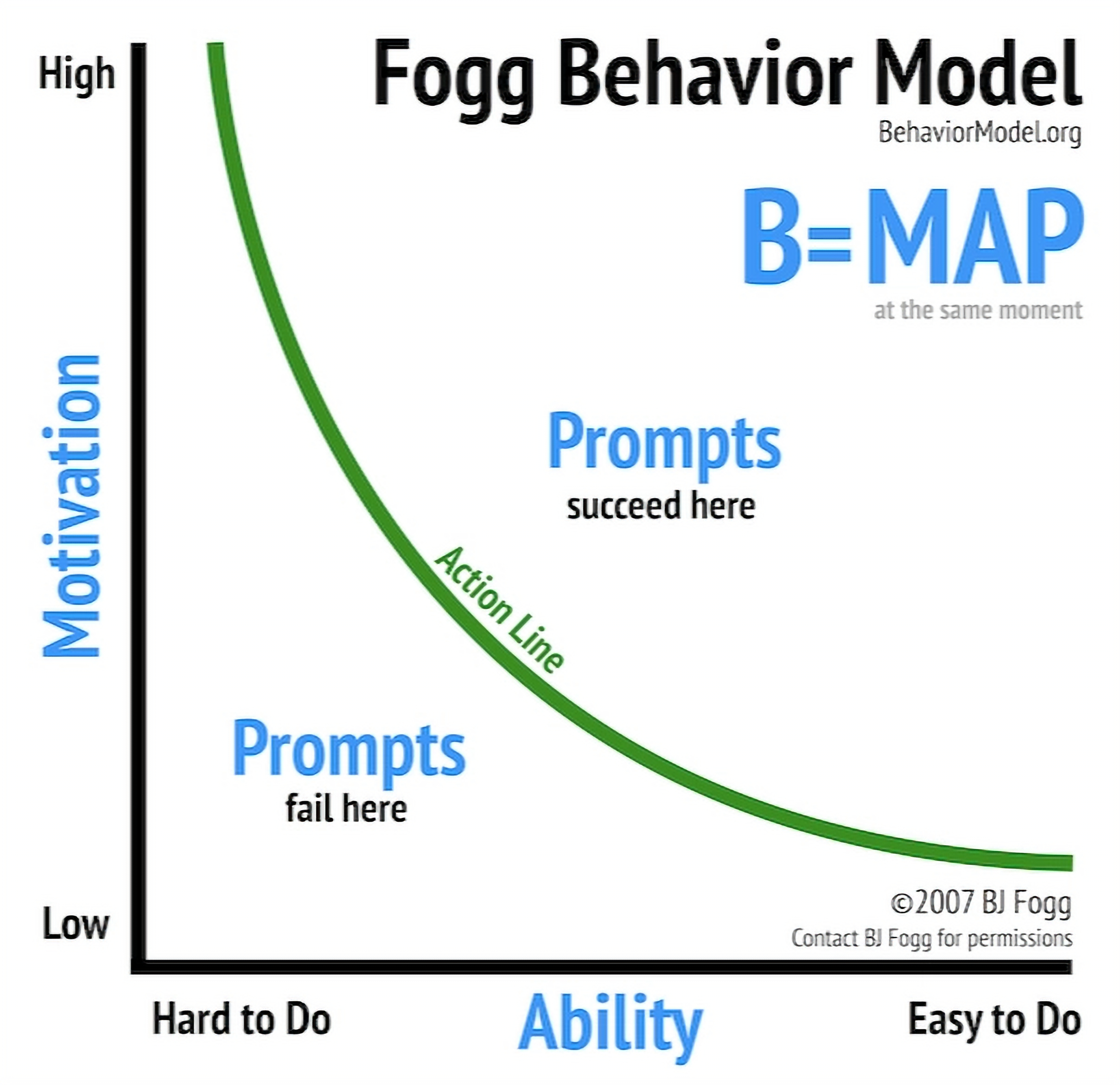
Fogg's Behavior Model (Fogg, 2009)
For the design of digital platforms oriented toward sustainability, the implication is direct: the intention to act is usually present, but execution is blocked by perceived difficulty, the absence of clear opportunities, or the lack of signals that activate the behavior at the right moment. The model indicates precisely where to intervene.
The FBM belongs to the tradition of cognitive-behavioral psychology [7] and aligns with the Theory of Planned Behavior (Ajzen, 1991), which identifies three determining factors of behavior: the personal attitude toward the action, perceived social norms, and the degree of control the individual feels over their own capacity to act. Unlike earlier approaches, the FBM shows how the user's internal variables must synchronize with external elements for change to be sustainable over time.
Motivation (M): What Drives Action
Fogg distinguishes three dual motivational axes: pleasure/pain, hope/fear, and social acceptance/rejection (Fogg, 2003). People do not act for abstract reasons, but out of a desire to move toward rewards or away from negative consequences.
In the field of sustainability, this means understanding what really moves each person: the satisfaction of reducing their environmental footprint, the hope of contributing to collective well-being, or the recognition they receive from their community for adopting responsible practices. The United Nations Sustainable Development Goals (SDGs) constitute a normative reference framework that can guide the design of interventions for environmental action (United Nations, 2015).
Ability (A): Simplifying the Action
Fogg defines ability not as technical skill, but as perceived simplicity [8]: the easier an action is to perform, the greater the probability that it will occur (Fogg, 2009). This principle guides behavioral design [9] in sustainability: reducing steps, eliminating unnecessary decisions, and offering clear guidance increases the likelihood that a person will act.
Digital applications that display geolocated sustainable actions or recommendations tailored to the local context increase the perception of self-efficacy: the conviction that one is capable of carrying out the desired action. By reducing perceived complexity, design closes the gap between intention and behavior.
Trigger (T): The Signal That Activates Action
The trigger is the external stimulus that prompts action at the right moment. To be effective, it must synchronize with the user's internal state: their current combination of motivation and ability. Fogg (2009) distinguishes three types:
Facilitators: useful when motivation is high but ability is limited. For example, a step-by-step tutorial on how to sort waste correctly.
Signals: act as reminders when both motivation and ability are already sufficient. A notification informing about the day of recycling collection.
Sparks: generate emotional momentum when ability is present but motivation has waned. A message showing the cumulative positive impact of a community's actions.
Social influence amplifies the effect of triggers: when a sustainable behavior becomes visible within a community, it can consolidate as a descriptive norm and facilitate its adoption by other members of the group (Nolan, Schultz, Cialdini, Goldstein, and Griskevicius, 2008).
Captology and Persuasive Design: Technology in the Service of Change
Captology, founded by Fogg (2003), studies how persuasive technologies [10] can ethically and effectively influence human behavior. Its persuasive design principles include: the reduction of complex tasks to minimal actions; step-by-step guidance of the user to avoid distractions (the tunnel principle); contextual interventions at critical moments; personalization of the experience according to the user's preferences; clear visualization of progress through self-monitoring; and reinforcement through recognition and community support.
Integrating these principles into digital platforms reduces barriers, increases motivation, and encourages the repetition of behaviors, which is a necessary condition for the formation of sustainable habits.
Gamification and Social Recognition
Social recognition carries real weight in the adoption of sustainable behaviors. Research on social norms shows that perceiving that other members of a community are acting responsibly can positively influence one's own behavior, especially when that information is presented visibly and immediately (Schultz, Nolan, Cialdini, Goldstein, and Griskevicius, 2007). Gamification — points, badges, levels — can strengthen this effect by incentivizing participation and transforming small actions into repeated commitments.
Gamification does not always produce immediate permanent change, but it fosters micro-commitments that, through repetition and social recognition, can become habits. A sense of belonging and community identity helps here. Place attachment has been identified as a relevant factor in explaining continuity in environmental action (Wynveen, Kyle, & Sutton, 2012).
Practical Application: A Proposed Digital Platform for Sustainability
A digital platform integrating the Fogg model, captology, and gamification could be structured around the following elements: quick logging of sustainable actions completable in under a minute; documentation through photo capture with SDG tagging and automatic geolocation; a repository of best practices in visual formats that facilitate replication; a personal impact dashboard with metrics such as CO₂ avoided, water saved, and contributions to the SDGs; social recognition through real-time visualization of community achievements; basic gamification with points, levels, and badges; and short weekly challenges to encourage continuity.
In this architecture, motivation arises from content and social achievements; ability is strengthened through simple, well-guided actions; and triggers are activated through social interaction and contextual notifications.
The Case of Too Good To Go
An illustrative example of how the FBM can be applied to sustainability is Too Good To Go, a platform against food waste founded in 2015 in Copenhagen, Denmark. The mechanisms described below represent the type of strategies a platform of this kind might implement; they do not constitute a verified description of its exact operation. The behavior it promotes — buying and picking up a "surprise bag" of surplus food — is activated through the three components of the FBM:
Motivation (M): the app does not rely solely on altruism. It combines the pleasure of financial savings (quality food at roughly a third of its price), the hope of reducing environmental impact, and a sense of belonging to a community of food-waste "heroes." Fogg's three motivational axes operate simultaneously.
Ability (A): geolocation shows nearby venues, eliminating the effort of searching. The "surprise bag" removes the cognitively demanding decision of choosing dishes, and payment is completed in a few steps from the phone, increasing the perception of self-efficacy.
Trigger (T): if a user usually buys late in the day, the app can send a push notification a few minutes beforehand as a reminder signal. If a user has been inactive for a while, emotionally reactivating messages highlighting the community's accumulated impact act as motivators.
The result is that the behavior occurs because the trigger arrives at a moment when motivation and ability are sufficient to cross the action threshold.

The Too Good To Go app
Examples in Cities, Schools, and Companies
The following examples show how the FBM (M–A–T), together with captology, gamification, and persuasive design, turns sustainable intention into simple, repeatable, and socially reinforced actions across three domains: cities, schools, and businesses.
Cities: Sustainable Mobility
A municipal digital system can encourage low-emission transport through dashboards comparing sustainable performance between neighborhoods and visualizing collectively avoided CO₂. Simplified maps with one-click selectable routes reduce the ability barrier. Geolocated notifications that alert users when they are near a bike station or a public transport hub act as effective triggers.
Schools: Responsible Habits
An educational app for logging students' sustainable actions can generate motivation through friendly competitions between classes and visible weekly recognition for the entire school community. An ultra-simplified log — a single click to confirm actions like "I brought my reusable bottle" — minimizes the ability barrier. Automatic reminders before recess or at the school entrance function as strategic triggers.
Businesses: Energy Efficiency
An internal corporate tool can guide employees toward reducing unnecessary energy consumption. A dashboard visible in common areas showing accumulated savings per team fosters shared responsibility. Contextualized instructions facilitate action, and end-of-day notifications or alerts linked to activity sensors function as triggers well synchronized with the user's state.
Conclusions
BJ Fogg's Behavior Model offers a rigorous framework for understanding why sustainable intention rarely translates into action, and for designing interventions that close that gap. When motivation, ability, and triggers are coherently integrated into digital platforms, sustainable behaviors stop depending solely on individual willpower and become accessible choices, socially reinforced and aligned with everyday routines.
The examples in cities, schools, and businesses show that persuasive design and gamification, when well applied, generate more stable and visible commitments, facilitate cooperation, and contribute to the formation of social norms favorable to environmental change. With the right mechanisms, sustainability can become a repeatable, measurable, and socially validated behavior.
Notes
[1] Psychological barriers to climate mitigation: internal reasons — denial, psychological distance, fear of change — that make it difficult for people to adopt behaviors aimed at reducing environmental impact (Gifford, 2011).
[2] BJ Fogg is a researcher in human behavior and technology and director of the Behavior Design Lab at Stanford University. He is the creator of the Behavior Model (FBM) and the founder of captology, a discipline that studies how technology can ethically influence human habits.
[3] Reducing behavioral friction means simplifying or eliminating the obstacles — complexity, doubt, lack of time — that make it difficult for a person to carry out a desired action, thereby facilitating the adoption of new behaviors.
[4] Persuasive design: a technique that applies psychological principles to the design of digital products and environments to motivate the user to perform specific actions. Its strategies include reducing steps, personalization, feedback, and social rewards. Example: a sustainability platform that shows in real time the CO₂ avoided by the community to encourage ongoing participation.
[5] Environmental psychology: a branch of psychology that studies how the physical and social environment influences human behavior and sustainable decision-making.
[6] Theory of Planned Behavior (Ajzen, 1991): holds that the likelihood of performing a behavior depends on the individual's intention, which is formed from three factors: personal attitudes toward the action, perceived social norms, and the perceived degree of control over one's own behavior. This framework helps explain the motivations behind sustainable decisions and guides the design of interventions to increase their adoption.
[7] Cognitive-behavioral psychology: a discipline that analyzes how thoughts, emotions, and external stimuli interact in the formation and change of human behaviors. Unlike classic behaviorism, which focuses exclusively on observable stimuli and responses, it incorporates internal mental processes as part of the explanation for behavior.
[8] Perceived simplicity is the feeling that a product or system is easy to understand and use, regardless of its internal complexity. It depends on the abilities and needs of each user and is achieved by eliminating unnecessary elements, organizing information clearly, and drawing on principles of visual psychology. It does not mean reducing functionality, but presenting complex tools intuitively so that people can use them without feeling overwhelmed.
[9] Behavioral design: an approach that applies principles from psychology and behavioral science to the design of products, services, or environments, with the goal of positively and ethically influencing people's decisions. It involves creating experiences and interfaces that facilitate and motivate the adoption of desired behaviors — such as sustainable or healthy habits — through the simplification of processes, the use of stimuli, and the reinforcement of relevant cues.
[10] Persuasive technologies: digital systems designed to influence attitudes or behaviors without resorting to coercion. They use principles from psychology, design, and communication to ethically motivate, facilitate, or guide specific actions (Fogg, 2003).
Appendix
A real example that illustrates the application of Fogg's Model (B = M × A × T) in sustainability is Too Good To Go, a global platform to fight food waste, created in 2015 in Denmark.
The behavior (B): The user buys and rescues a "surprise pack" of surplus food.
Motivation (M): Alignment of Dual Axes
The application doesn't depend solely on altruism. It attacks the motivational axes simultaneously:
Pleasure/Pain: Offers quality food at a very reduced price (1/3 of its value). The user feels the pleasure of saving and avoids the pain of spending a lot of money.
Hope/Fear: Appeals to ecological conscience. The user feels hope knowing they are "saving" food and reducing CO2, mitigating the fear of climate change.
Social Acceptance: Upon completing the purchase, the app shows how many "heroes" have saved food today, generating a sense of belonging and acceptance in a responsible community.
Ability (A): Technology for Simplicity
Following Fogg's principle that "Ability = Simplicity," the app eliminates operational friction:
Georeferencing: The app shows establishments near the user's current location, eliminating search effort.
Decision reduction: The user buys a "Surprise Pack." They don't have to choose dish by dish (which requires cognitive effort), they simply reserve and pick up.
Payment ease: Everything is managed from the mobile in two clicks, increasing the perception of self-efficacy.
Trigger (T): Synchronization with Internal State
The application uses external triggers designed according to the user's context:
Signal (Reminder Trigger): If the user usually buys at 6:00 PM, the app sends a push notification at 5:45 PM: "Dinner time! Save a pack near you." Here, motivation and ability are already high; only the reminder is needed.
Motivator (Emotional Trigger): If the user has been inactive for a while, they send messages like: "We've saved 5,000 tons of CO2, we miss you." This seeks to reactivate motivation through social influence.
Facilitator: When a new user registers, a brief overlay tutorial teaches them how to validate their purchase at the store, increasing their technical ability.
Result
The behavior occurs (B) because the Trigger arrives when Motivation (savings + ecology) is high and Ability (it's easy and nearby) is sufficient to cross the action line.
References
Ajzen, I. (1991). The theory of planned behavior. Organizational Behavior and Human Decision Processes, 50(2), 179–211. https://doi.org/10.1016/0749-5978(91)90020-T
European Commission. (2017). Special Eurobarometer 459: Climate change. https://ec.europa.eu/clima/sites/clima/files/support/docs/report_2017_en.pdf
Fogg, B. J. (2003). Persuasive technology: Using computers to change what we think and do. Morgan Kaufmann Publishers. https://doi.org/10.1016/B978-1-55860-643-2.X5000-8
Fogg, B. J. (2009). A behavior model for persuasive design. In Proceedings of the 4th International Conference on Persuasive Technology (Article 40). ACM. https://doi.org/10.1145/1541948.1541999
Gifford, R. (2011). The dragons of inaction: Psychological barriers that limit climate change mitigation and adaptation. American Psychologist, 66(4), 290–302. https://doi.org/10.1037/a0023566
Lorenzoni, I., Nicholson-Cole, S., & Whitmarsh, L. (2007). Barriers perceived to engaging with climate change among the UK public and their policy implications. Global Environmental Change, 17(3-4), 445–459. https://doi.org/10.1016/j.gloenvcha.2007.01.004
Nolan, J. M., Schultz, P. W., Cialdini, R. B., Goldstein, N. J., & Griskevicius, V. (2008). Normative social influence is underdetected. Personality and Social Psychology Bulletin, 34(7), 913–923. https://doi.org/10.1177/0146167208316691
Pew Research Center. (2015). Climate change seen as top global threat. https://www.pewresearch.org/global/2015/07/14/climate-change-seen-as-top-global-threat/
Schultz, P. W., Nolan, J. M., Cialdini, R. B., Goldstein, N. J., & Griskevicius, V. (2007). The constructive, destructive, and reconstructive power of social norms. Psychological Science, 18(5), 429–434. https://doi.org/10.1111/j.1467-9280.2007.01917.x
United Nations. (2015). Transforming our world: The 2030 Agenda for Sustainable Development. https://www.un.org/ga/search/view_doc.asp?symbol=A/RES/70/1&Lang=E
UNESCO. (2017). Education for Sustainable Development Goals: Learning objectives. https://unesdoc.unesco.org/ark:/48223/pf0000247444
Wynveen, C. J., Kyle, G. T., & Sutton, S. G. (2012). Place meanings as antecedents of place attachment among marine reserve users. Environment and Behavior, 44(5), 570–589. https://doi.org/10.1177/0013916511402059




Współczesne technologie informatyczne rozwijają się bardzo szybko, dlatego materiały edukacyjne powinny koncentrować się nie tylko na konkretnych narzędziach, ale także na podstawowych zasadach działania systemów. Artykuły o programowaniu, sieciach, bazach danych, bezpieczeństwie oraz chmurze mogą tworzyć solidną bazę wiedzy. Szczególnie wartościowe są poradniki zawierające praktyczne przykłady, dzięki którym czytelnik może samodzielnie przetestować omawiane rozwiązania.
Profesjonalne szkolenie pilotów wymaga połączenia wiedzy teoretycznej, praktyki oraz bardzo dobrego przygotowania do sytuacji nietypowych. Materiały edukacyjne dotyczące aerodynamiki, meteorologii, nawigacji oraz procedur lotniczych mogą być interesujące również dla osób, które dopiero rozważają rozpoczęcie nauki. Warto byłoby stworzyć przejrzystą bazę wiedzy przedstawiającą kolejne etapy szkolenia, wymagania oraz podstawowe pojęcia związane z lotnictwem cywilnym.
Tematy związane z logistyka i transport mają duże znaczenie dla współczesnego biznesu, szczególnie przy rosnącym znaczeniu handlu internetowego i międzynarodowych łańcuchów dostaw. Edukacyjne artykuły mogą wyjaśniać zagadnienia magazynowania, planowania tras, zarządzania zapasami oraz optymalizacji kosztów. Warto również przedstawiać konkretne przykłady pokazujące, jak technologie i analiza danych pomagają usprawniać procesy logistyczne w małych i dużych przedsiębiorstwach.
Rozwijanie kreatywne umiejętności może być przydatne nie tylko w zawodach związanych ze sztuką czy projektowaniem. Kreatywność pomaga również w marketingu, biznesie, edukacji i rozwiązywaniu codziennych problemów. Dobry serwis edukacyjny mógłby publikować ćwiczenia, przykłady projektów oraz praktyczne materiały dotyczące projektowania, pisania, tworzenia treści i pracy z narzędziami cyfrowymi. Szczególnie ciekawe byłoby pokazanie całego procesu od pomysłu do gotowego projektu.
Systematyczny rozwój umiejętności jest dziś ważny praktycznie w każdej branży, ponieważ wymagania zawodowe zmieniają się znacznie szybciej niż jeszcze kilka lat temu. Warto łączyć naukę wiedzy technicznej z kompetencjami miękkimi, takimi jak komunikacja, organizacja pracy czy rozwiązywanie problemów. Przydatne byłyby krótkie poradniki, ćwiczenia praktyczne oraz ścieżki nauki dla osób na różnych poziomach zaawansowania. Dzięki temu czytelnik może łatwiej zaplanować własny rozwój i mierzyć postępy.